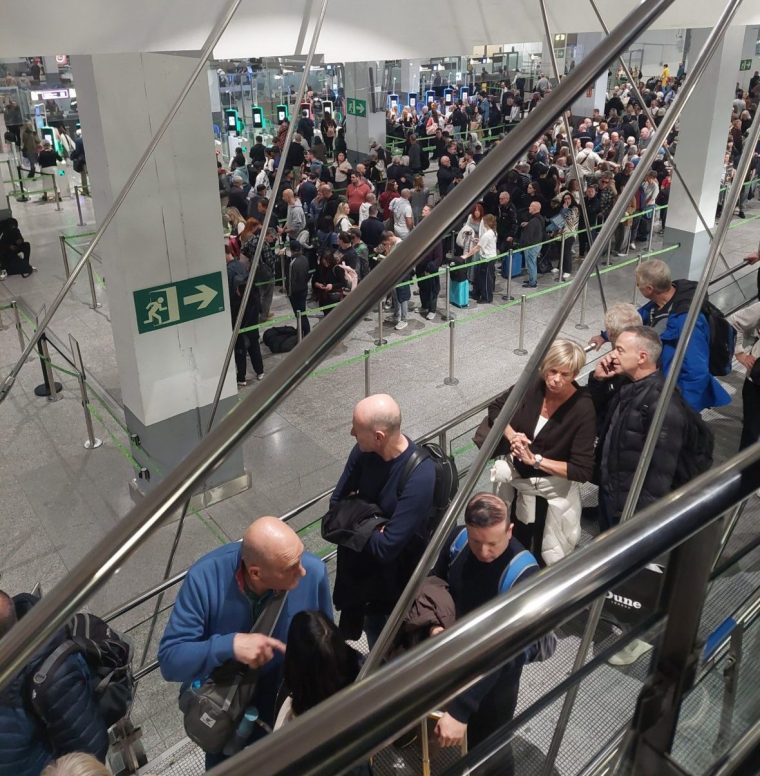
Airlines and airlines have warned of Easter travel chaos as the deadline to fully implement new border checks for non-EU citizens.
The Entry-Exit System (EES) for travel to the Schengen area requires third-party nationals – including British nationals – to have facial photographs and fingerprints when they arrive at EU borders.
The phased rollout of the system, which began in October and led to airport queues of up to seven hours, ends over the Easter holiday, sparking fears of major delays from the increased processing time.
ACI Europe, which represents airports across the continent, and Airlines for Europe (A4E), the trade association for the main carriers, called on the European Commission and the member states to continue to allow the complete suspension of the EES, a step that had prevented the interruption of the “crisis” since the start of the system.
This week, Belgium announced it was suspending the introduction of EES due to unacceptable waiting times. At the same time, technical problems in France have stopped the full publication of checks for car passengers at Dover and Eurotunnel.
European airports and airlines have expressed “deep concern” about travel disruptions for the upcoming summer season – and over the next few weeks as travelers head overseas for the Easter holidays.
EasyJet said this Easter was set to be its busiest ever, with around 30,000 flights and 5.2 million seats across Europe during the two-week school break.
The finance director said Tenerife, Lanzarote, Alicante and Malaga were among the most popular destinations – all of which have been affected by long EES queues in recent months.
Passenger data during the phased launch of EES showed a “continuing deterioration” in waiting times at border points due to biometric checks, ACI Europe and A4E said.
Problems causing delays include a shortage of border control personnel, technical issues with self-service kiosks, and limited use of border control gates (ABC).
Exacerbating the hold-up, the EES pre-registration system, which allows passengers to enter their facial and passport photo details before travelling, is currently only used by Sweden and Portugal.
Olivier Jankovec, managing director of ACI Europe, and Ourania Georgoutsakou, managing director of A4E, said: “Passengers entering the Schengen area may have to wait even longer at border control during Easter due to ongoing operational problems regarding the EES rollout.”
From 31 March, all third country nationals must be checked by the EES upon arrival and departure. Before Tuesday, the requirement was for at least half of the passengers to be registered.
The transition period, which allows member states to suspend checks entirely, ends on April 9, and airlines and airports warn that this removes important safeguards for managing peak demand.
Manual printing of passports is also due to end on April 9.
A number of airlines across Europe had to partially or fully suspend EES, including France, Italy, Spain, Portugal, Greece, Switzerland, Belgium and Germany, said a spokesperson for ACI Europe.
Of those, Belgium, Greece, Portugal and Italy saw some of the longest waiting times.
Brussels Airport reported queues of two to three hours at peak times, Athens International Airport and Faro Airport saw queues of more than two hours, while Frankfurt Airport said passengers were stuck for up to 125 minutes.
The leaders of ACI Europe and A4E said: “We reiterate our appeal to the European Commission and the Member States to extend the possibility of suspending the EES in full or in part – where necessary – throughout the summer of 2026.
“This flexibility has proven to be essential to prevent serious performance disruptions during the ongoing operation of the system.”
If the technical and operational issues with the EES are not resolved that flexibility should remain in place during the upcoming peak travel season, such as the winter of 2026/2027, they added.
A partial suspension of the EES means that passengers are still registered, but none of their biometrics are captured, while a full suspension means that no data at all will be captured.
The norm of waiting times of an hour or more at Schengen borders is undermining the passenger experience and the efficiency of Europe’s air transport system, trade associations have warned.
The European Commission says the rollout of the EES is “progressing well” as most member states are already registering more than 75 percent of border crossings.
The spokesman said: “But in a few member countries, technical problems have been found.
“The Commission is working closely with these member states. We are continuing to monitor the state of their country’s performance.”
The Commission said that member states can still suspend the registration of EES biometric data until September.
Data can also be entered manually if the system is temporarily down in the border area.
In both cases, passports will need to continue to be printed.
#Spain #Greece #Germany #hit #postBrexit #checkin #queues #hours